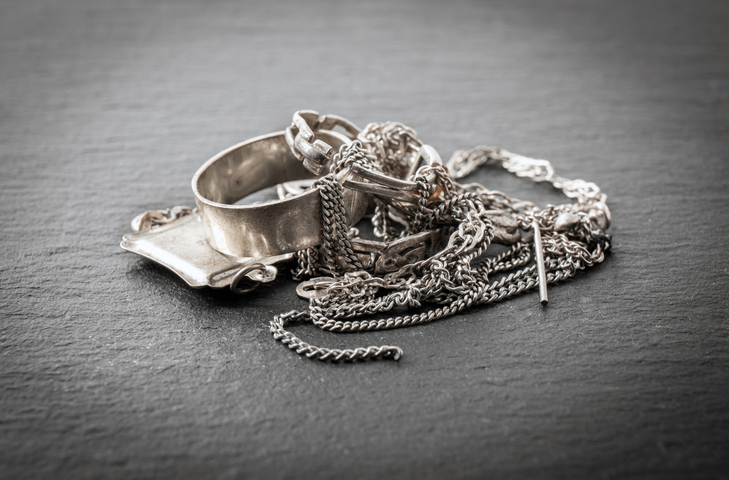
At a glance, platinum and silver look nearly identical. Both share that cool, brilliant white luster that has made them staples in jewelry boxes and investment portfolios for centuries. However, the similarities end at the surface.
As expert jewelry buyers in Chicago since 1980, we see these metals daily. Understanding the physical and financial differences is crucial when you’re looking to sell precious metals.
Platinum vs. Silver: Comparison Guide
Understanding the distinct properties of these two white metals helps in making informed buying or selling decisions.
| Feature | Platinum | Silver (Sterling) |
| Purity | Usually 90%–95% | 92.5% (.925) |
| Weight | Very Dense (Extremely Heavy) | Lightweight |
| Durability | High (Does not wear away) | Low (Soft; can bend/scratch) |
| Tarnish | Never (Develops a Patina) | Frequent (Oxidizes/Turns Black) |
| Rarity | Extremely Rare | Relatively Common |
| Main Use | Bridal Jewelry / Bullion | Fashion Jewelry / Coins / Flatware |
Identification Methods
Weight & Density Test
The fastest way to tell these two apart is by their weight. Platinum is one of the densest elements on Earth—roughly 60% heavier than gold and nearly twice as heavy as silver.
If you hold a platinum ring in one hand and a silver ring of the same size in the other, the platinum piece will feel “substantial” or “hefty.” Silver feels surprisingly light, almost like aluminum by comparison. If you have a piece that looks like platinum but feels light, it is almost certainly silver or white gold.
Durability: “Patina” vs. Tarnish
While silver is a beautiful metal, it is quite soft. Over time, silver jewelry will often thin out, bend, or even snap under consistent pressure.
Silver reacts with sulfur in the air, causing it to tarnish (turn black or yellowish). If a piece has dark residue in the crevices or turns your skin green or black, it is silver.
Platinum does not tarnish. It does, however, develop a “patina.” When platinum is scratched, the metal isn’t lost; it is simply displaced. Over time, this gives the metal a soft, matte finish that many vintage jewelry collectors prize.
Check the Hallmarks
Look inside the band or on the clasp for small engravings.
- Silver: Look for 925, Sterling, or S925.
- Platinum: Look for PLAT, PT, 950, or 900. You may also see 10% Irid, indicating a high-quality platinum-iridium alloy used in fine jewelry.
The “Gemstone Rule”
Historically, high-quality diamonds and precious gemstones were rarely set in silver because the metal is too soft to hold them securely for a lifetime. Jewelers traditionally reserved silver for semi-precious stones like coral, turquoise, or amethyst. If you see a high-clarity diamond, it is much more likely to be set in platinum or white gold.
The Magnet & Ice Tests
Neither silver nor platinum is magnetic. If your “precious metal” sticks to a magnet, it is likely a base metal fake. Furthermore, silver is the best thermal conductor of all metals. If you place a cube of ice on a silver coin or bar, the ice will begin to melt instantly as if placed on a hot surface—much faster than it would on platinum.
What About White Gold?
White gold is often the third option for those seeking a white metal look. It is an alloy of yellow gold mixed with metals like nickel or zinc, then plated in Rhodium to achieve its bright finish.
Unlike platinum, which is naturally white, white gold will eventually show a yellowish tint as the plating wears off, requiring it to be re-plated every few years. It is more durable than silver but lacks the pure, hypoallergenic properties of platinum.
Get a Professional Evaluation in Chicago
DIY tests are a great starting point, but they aren’t foolproof. Many vintage pieces have had their hallmarks worn away or were made in eras where stamping wasn’t strictly required.
At Chicago Gold Gallery, we use professional testing methods to determine the exact purity of your items without causing any damage. Our expert appraisers have over 40 years of experience as the premier destination to sell silver in Chicago, providing precise evaluations for silver coins, bullion, scrap silver, and designer jewelry.
Visit us today at 1236 W. Devon Avenue, Chicago, or call us at 773-338-7787 for a free verbal appraisal.